
Choosing the right dirt bike for your child can be a daunting task, especially when comparing popular models like the Honda CRF50 and Yamaha PW50. Both bikes have unique features that cater to different skill levels and physical sizes, making them ideal for young riders.
The CRF50, with its robust four-stroke engine and three-speed transmission, offers a more versatile riding experience, while the PW50, a two-stroke classic, provides a simpler, lighter option for beginners. In this article, we will explore the differences between the CRF50 vs PW50, including their performance, ergonomics, and maintenance needs.
By the end, parents will have a clear understanding of which bike is best suited for their child’s first dirt biking experience, ensuring safety and enjoyment as they embark on this thrilling adventure.
Overview of the CRF50 and PW50
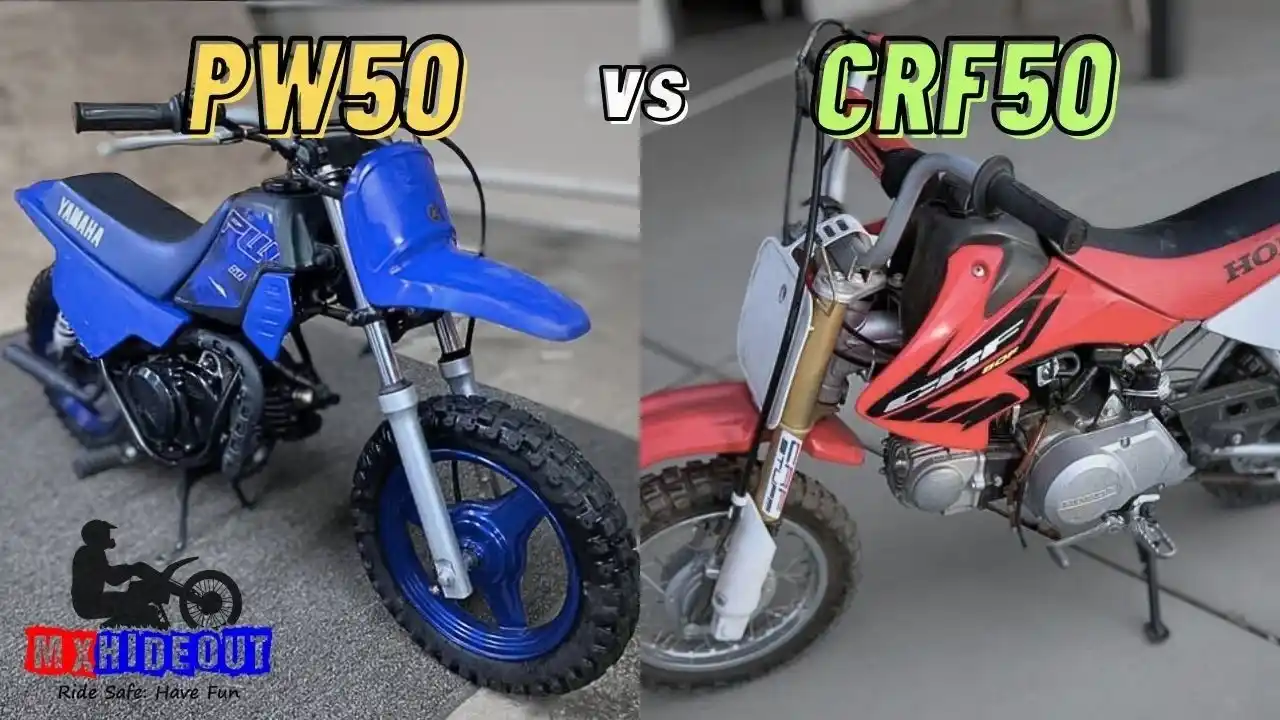
The Honda CRF50 and Yamaha PW50 are two of the most popular entry-level dirt bikes available for kids. Both bikes have their unique characteristics, making them suitable for different types of young riders.
The CRF50 is built for slightly taller children and offers a more powerful engine, while the PW50 is designed for smaller riders who are just starting out.
Brief History of the CRF50 and PW50
The Honda CRF50 has been a staple in the beginner dirt bike market since its introduction, known for its reliability and ease of use. It features a four-stroke engine and is designed for young riders to learn the fundamentals of riding.
The Yamaha PW50, on the other hand, has been around for decades and is cherished for its lightweight design and user-friendly operation, making it a favorite among parents looking for a first bike for their children.
Target Audience and Ideal Age Groups
The CRF50 is generally recommended for children aged 5 to 7 years old, while the PW50 is suitable for younger riders, typically between 3 to 6 years old. However, height and comfort on the bike are crucial factors, and it’s advisable to have children sit on both models to determine which fits them best.
Key Features Comparison
| Feature | Honda CRF50 | Yamaha PW50 |
|---|---|---|
| Engine Type | 4-Stroke | 2-Stroke |
| Weight | 50 kg | 39 kg |
| Seat Height | 548 mm | 485 mm |
| Recommended Age | 5-7 years | 3-6 years |
This table highlights the key specifications of both models. The CRF50 is heavier and taller, making it more suitable for older or taller children who can handle its additional weight and power.
In contrast, the PW50 is lighter and has a lower seat height, allowing younger or smaller riders to feel more comfortable and secure. The choice between the two should factor in the child’s size, experience, and intended usage.
Engine and Performance Analysis
Comparing the engines of the CRF50 and PW50 reveals significant differences in performance characteristics. The CRF50 offers a smoother power delivery suitable for various terrains, while the PW50 is designed for easier handling and lower speeds, making it ideal for beginners.
CRF50 Engine Specs and Performance
The Honda CRF50 is powered by a 49cc air-cooled, four-stroke engine, equipped with a three-speed semi-automatic transmission. This setup allows for straightforward gear changes without the risk of stalling, which is beneficial for young riders still mastering their skills.
The engine produces a significant amount of torque, making it capable of tackling inclines and uneven terrain with ease.
PW50 Engine Specs and Performance
The Yamaha PW50 features a 49cc two-stroke engine with a centrifugal clutch and a single-speed automatic transmission. This configuration makes it easy for beginners to operate, as they do not need to worry about shifting gears.
However, the power delivery is less linear compared to the CRF50, often requiring more throttle input to gain momentum, which can be challenging for smaller riders.
Power Delivery and Torque Comparison
| Specification | Honda CRF50 | Yamaha PW50 |
|---|---|---|
| Horsepower | 6 HP | 2 HP |
| Torque | 10 Nm | 6 Nm |
| Gear Ratios | Three-speed | Single-speed |
The performance comparison showcases that the CRF50 offers significantly higher horsepower and torque than the PW50. This results in better acceleration and climbing ability, making the CRF50 more suitable for varied terrains.
In contrast, the PW50’s simplicity and lower power make it a great introductory bike, but it may struggle with steeper inclines and rougher terrains.
Ergonomics and Size Considerations
When selecting a dirt bike for children, ergonomics play a crucial role in their comfort and control over the bike. The dimensions of both the CRF50 and PW50 will greatly influence a child’s ability to handle the bike effectively.
Seat Height and Rider Fit
The seat height for the CRF50 is approximately 548 mm, while the PW50 is notably lower at 485 mm. This difference can significantly affect younger and shorter riders, as they may be unable to comfortably reach the ground on the taller bike, leading to a lack of confidence when riding.
Weight Differences and Handling
The CRF50 weighs around 50 kg, while the PW50 is lighter at 39 kg. The weight distribution impacts how each bike handles during maneuvers.
A lighter bike like the PW50 allows for easier control and less physical strain on younger riders, whereas the heavier CRF50 may provide more stability but can be cumbersome for smaller children to manage.
Adjustability Options
Both bikes offer limited adjustability features. The CRF50 can be fitted with lowering kits, while the PW50 has a throttle limiter that allows parents to control speed, making it safer for inexperienced riders.
Parents should consider these options when selecting the right bike for their child.
| Specification | Honda CRF50 | Yamaha PW50 |
|---|---|---|
| Seat Height | 548 mm | 485 mm |
| Weight | 50 kg | 39 kg |
| Recommended Rider Height | 120 cm+ | 100 cm+ |
This table illustrates the ergonomic specifications of both bikes. The PW50 is more suitable for smaller riders with its lower seat height and lighter weight.
In contrast, the CRF50 is designed for slightly taller children, making it a better long-term investment as they grow. Proper fit is essential for building confidence and skill in young riders, so parents should ensure that their child can comfortably reach the ground when seated.
Suspension and Handling
The suspension systems on both bikes affect how they handle different terrains. Evaluating the suspension features of the CRF50 and PW50 can help parents understand which bike is better suited for their child’s riding environment.
CRF50 Suspension Features
The Honda CRF50 features an inverted telescopic front fork with 87 mm of travel and a rear monoshock with 70 mm of travel. This design provides a smoother ride over rough terrain and allows for better maneuverability.
The suspension absorbs bumps effectively, contributing to a more stable ride.
PW50 Suspension Features
In contrast, the Yamaha PW50 has a more basic suspension system with dual rear shocks and a telescopic front fork. While it provides adequate support for beginner riders, the suspension is less sophisticated compared to the CRF50.
This might limit performance on uneven surfaces but is generally suitable for flat, beginner-friendly trails.
Real-World Handling Scenarios
| Feature | Honda CRF50 | Yamaha PW50 |
|---|---|---|
| Front Suspension Travel | 87 mm | 80 mm |
| Rear Suspension Travel | 70 mm | 60 mm |
| Type of Terrain | Varied | Flat |
This table compares the suspension travel and handling capabilities of both bikes. The CRF50’s superior suspension travel makes it more adept at handling varied terrains, providing a smoother and more controlled ride.
Conversely, the PW50’s basic suspension may not perform as well on rough surfaces but is adequate for beginners riding on flat ground. This difference is notable for parents to consider based on where their child is likely to ride.
Maintenance and Longevity
Understanding the maintenance needs of each dirt bike is crucial for long-term ownership. Both the CRF50 and PW50 are designed for easy upkeep, but there are notable differences in their maintenance requirements.
Routine Maintenance Needs
The Honda CRF50 requires regular oil changes, air filter maintenance, and periodic checks on the chain tension. These routine tasks ensure the longevity and reliability of the bike.
In contrast, the Yamaha PW50 has a simpler maintenance routine due to its oil-injection system that eliminates the need for pre-mixing fuel and oil, making it a low-maintenance option.
Reliability and Common Issues
Both models are known for their durability, but the CRF50 generally has a better reputation for long-term reliability. The PW50 may experience issues with its two-stroke engine if the oil reservoir isn’t regularly checked, which can lead to engine failure.
Parents should be aware of these potential issues to ensure their child has a safe and enjoyable riding experience.
Aftermarket Support
The CRF50 benefits from a vast aftermarket support network, allowing for easy upgrades and modifications. This is particularly advantageous as children grow and require bike adjustments to accommodate their increasing size and skill level.
The PW50, being less popular in the aftermarket scene, has limited options for upgrades but still has basic parts readily available.
| Maintenance Aspect | Honda CRF50 | Yamaha PW50 |
|---|---|---|
| Routine Maintenance | Regular oil changes, chain checks | Check oil reservoir |
| Average Yearly Maintenance Costs | Low | Very low |
| Aftermarket Parts Availability | Extensive | Limited |
This table outlines the maintenance requirements and costs for both bikes. The CRF50 has a slightly higher maintenance demand due to its four-stroke engine but benefits from a wealth of aftermarket options.
The PW50, while easier to manage in terms of routine upkeep, may require more attention to its oil system to prevent issues. Parents should weigh these factors when deciding on a dirt bike for their child.
Safety Features and Learning Curve
Safety is paramount when it comes to children’s dirt biking. Both the CRF50 and PW50 incorporate features that enhance rider safety and facilitate the learning process.
Safety Features of CRF50
The Honda CRF50 comes equipped with an adjustable throttle limiter, allowing parents to control how fast their child can ride. The automatic clutch system also prevents stalling, making it easier for young riders to focus on balance and steering rather than managing gears.
Additionally, the robust frame and drum brakes provide reliable stopping power.
Safety Features of PW50
The Yamaha PW50 also includes a throttle limiter, which is especially useful for new riders still learning to gauge speed. Its lightweight design allows for easier handling, which can help prevent falls.
The bike’s low center of gravity contributes to stability, making it less intimidating for beginners.
Learning Curve for Young Riders
The learning curve for both bikes is manageable, but the PW50 tends to offer a gentler introduction to dirt biking. Its single-speed design allows young riders to focus solely on throttle control and balance without the added complexity of shifting gears.
The CRF50, while slightly more challenging due to its gears, provides a more versatile riding experience as kids develop their skills.
| Safety Feature | Honda CRF50 | Yamaha PW50 |
|---|---|---|
| Throttle Limiter | Yes | Yes |
| Automatic Clutch | Yes | No |
| Brakes | Drum | Drum |
This table compares the safety features of both bikes. Both the CRF50 and PW50 provide essential safety elements like a throttle limiter, but the CRF50’s automatic clutch offers an additional layer of security for young riders.
Parents should consider these features to ensure their child’s safety while they learn the fundamentals of dirt biking.
User Feedback and Real-World Experiences
Real-world experiences from parents and riders can provide valuable insights into the performance and usability of the CRF50 and PW50.
Parent Reviews on CRF50
Many parents praise the Honda CRF50 for its durability and ease of use. They note that the bike’s power delivery is smooth, making it easier for their children to learn without feeling overwhelmed.
The adjustable throttle limiter and automatic clutch are frequently highlighted as features that make the learning process safer and more enjoyable. Parents also appreciate the availability of aftermarket parts, allowing for modifications as their kids grow.
Parent Reviews on PW50
The Yamaha PW50 is often recommended for its lightweight design and user-friendly operation. Parents appreciate its simplicity, which makes it an excellent choice for very young riders.
However, some reviews indicate that children may outgrow the PW50 quickly, suggesting it might not be the best long-term investment. Nonetheless, many parents report that it serves as a fantastic introduction to dirt biking.
Rider Testimonials
Riders who started on either bike often share fond memories of their first experiences. Those who began with the CRF50 often mention how it taught them essential riding skills that translated well into later, more advanced riding.
Conversely, PW50 riders frequently recall the joy of their first rides, emphasizing the bike’s forgiving nature and ease of handling.
| Feedback Aspect | Honda CRF50 | Yamaha PW50 |
|---|---|---|
| User Satisfaction | High | Very High |
| Common Praises | Durability, Power | Lightweight, Ease of Use |
| Common Complaints | Weight for Small Riders | Power Limitations |
This table summarizes user feedback for both bikes. The high satisfaction ratings for both models reflect their popularity as beginner bikes.
While the CRF50 is praised for its durability and power, it can be heavy for smaller riders. The PW50, on the other hand, is celebrated for being lightweight and easy to manage, though it may lack the power that some riders desire as they progress.
Cost and Value for Money
Analyzing the cost of both bikes and their overall value can help parents make a more informed decision. Initial purchase price and long-term value retention are crucial factors to consider.
Initial Purchase Costs
The Honda CRF50 typically retails for around $2,598, while the Yamaha PW50 is generally priced at $2,500. While the difference in price may seem minimal, it can be a deciding factor for parents on a budget.
Resale Value Insights
Both bikes retain their value well, but the CRF50 often commands a higher resale price due to its popularity and versatility. Many parents report that they can sell their CRF50 for nearly the same price they purchased it for, even after a few years of use.
Long-Term Investment
Investing in a CRF50 may provide more extended use as children grow, thanks to its adaptable design and aftermarket support. The PW50, while excellent for beginners, may require a quicker upgrade once children gain confidence and outgrow it.
| Cost Aspect | Honda CRF50 | Yamaha PW50 |
|---|---|---|
| MSRP | $2,598 | $2,500 |
| Average Resale Price | $2,200 | $1,800 |
| Long-Term Value | High | Moderate |
This table outlines the cost and value considerations for both bikes. While the CRF50 has a slightly higher MSRP, its resale value and long-term investment potential make it a worthwhile consideration for parents.
The PW50, while more affordable initially, may not hold its value as well in the long run. Parents should evaluate their budget and their child’s growth potential when making a decision.
FAQs on CRF50 vs PW50
-
What is the ideal age for a child to start riding the CRF50 or PW50?
The ideal age for riding the CRF50 is generally between 5 to 7 years old, while the PW50 is suited for younger children, typically aged 3 to 6 years. However, height and comfort should be the primary considerations, so it’s crucial for children to sit on both models to determine the best fit.
-
How much do the CRF50 and PW50 weigh?
The Honda CRF50 weighs approximately 50 kg, while the Yamaha PW50 is lighter at around 39 kg. This weight difference can impact handling and control, especially for younger riders who may struggle with heavier bikes.
-
Is the PW50 suitable for racing?
The Yamaha PW50 is often used in beginner racing classes due to its manageable power and ease of use. However, it is primarily designed for recreational riding and may not provide the competitive edge that more advanced bikes offer.
-
What maintenance is required for each bike?
The Honda CRF50 requires routine oil changes, air filter maintenance, and chain checks, while the Yamaha PW50 has a simpler maintenance routine focused on monitoring the oil reservoir for its two-stroke engine. Both are generally low-maintenance options but require some attention to ensure longevity.
-
Can the CRF50 be used as a pit bike for adults?
Yes, the Honda CRF50 is often used as a pit bike for adults due to its durability and versatility. Many riders appreciate its robust build and the ability to modify it for various riding styles, making it a popular choice even among older riders.
The ideal age for riding the CRF50 is generally between 5 to 7 years old, while the PW50 is suited for younger children, typically aged 3 to 6 years. However, height and comfort should be the primary considerations, so it’s crucial for children to sit on both models to determine the best fit.
The Honda CRF50 weighs approximately 50 kg, while the Yamaha PW50 is lighter at around 39 kg. This weight difference can impact handling and control, especially for younger riders who may struggle with heavier bikes.
The Yamaha PW50 is often used in beginner racing classes due to its manageable power and ease of use. However, it is primarily designed for recreational riding and may not provide the competitive edge that more advanced bikes offer.
The Honda CRF50 requires routine oil changes, air filter maintenance, and chain checks, while the Yamaha PW50 has a simpler maintenance routine focused on monitoring the oil reservoir for its two-stroke engine. Both are generally low-maintenance options but require some attention to ensure longevity.
Yes, the Honda CRF50 is often used as a pit bike for adults due to its durability and versatility. Many riders appreciate its robust build and the ability to modify it for various riding styles, making it a popular choice even among older riders.
Conclusion
In conclusion, both the Honda CRF50 and Yamaha PW50 offer unique advantages that cater to different needs in young riders. The CRF50, with its robust engine and versatility, is ideal for slightly taller and more adventurous children, while the PW50 serves as a perfect introduction for those just starting out.
Ultimately, the choice between these two bikes will depend on the child’s size, experience level, and the intended riding environment. By understanding these differences, parents can confidently choose the best bike to ensure a safe and enjoyable riding experience for their kids.